In the 20th century, a number of thinkers studying mythology/religion noticed that myths of different cultures throughout history shared fundamental similarities in theme, structure, and symbolism despite being separated by both space and time.
Carl Jung and Joseph Campbell proposed that the reason for such similarities was due to the fact that many mythological themes and symbols emerge from an area of the mind called the collective unconscious. They believed a mind consists of:
1.) A personal unconscious – elements drawn from an individual’s life experience
2.) The collective unconscious – elements or cognitive structures that evolved over human history and are therefore common to all. These evolved cognitive structures are called Archetypes by Jung.
They cannot be observed directly, but manifest various images or symbolic patterns that form the basis of many myths, explaining how similar myths can arise in cultures separated by hundreds or thousands of years.
As Joseph Campbell noted “the symbols of mythology are not manufactured; they cannot be ordered, invented, or permanently suppressed. They are spontaneous productions of the psyche.”
As the manifestations of the deepest layers of the unconscious, myths are thought to reveal timeless truths about the yearnings, fears, and aspirations common to every individual.
In the words of Jung: “myths are first and foremost, psychic phenomena that reveal the nature of the soul. Myths have served various functions in different cultures across time.”
Psychological development via what Jung called the individuation process occurs when unconscious contents of the psyche are integrated into one’s conscious personality, resulting in the formation of what Jung called the true personality.
There are various ways in which unconscious content can be made conscious. Becoming aware of one’s dream life is the most well known. Exploring mythology symbolism is a lesser-known but equally effective way to bring unconscious content into the light of consciousness.
As Campbell explained: “These symbols stem from the psyche, they speak from and to the spirit, and they are in fact the vehicles of communication between the deeper depths of our spiritual life, and this relatively thin layer of consciousness, by which we govern our daylight existences.” Activating unconscious content is important because the unconscious contains unrealized potentials, which if discovered and integrated into one’s consciousness, can result in a personal transformation. To discover and nourish these potentials within Campbell called the pathway to bliss.
Myths of individuals undergoing heroic adventures as they attempt to actualize their higher potentials and find their own unique pathway to bliss are abundant in many cultures throughout history, while these myths vary in detail depending on their time and place of origin, they share a common pattern which Joseph Campbell coined the myth of the hero’s journey.
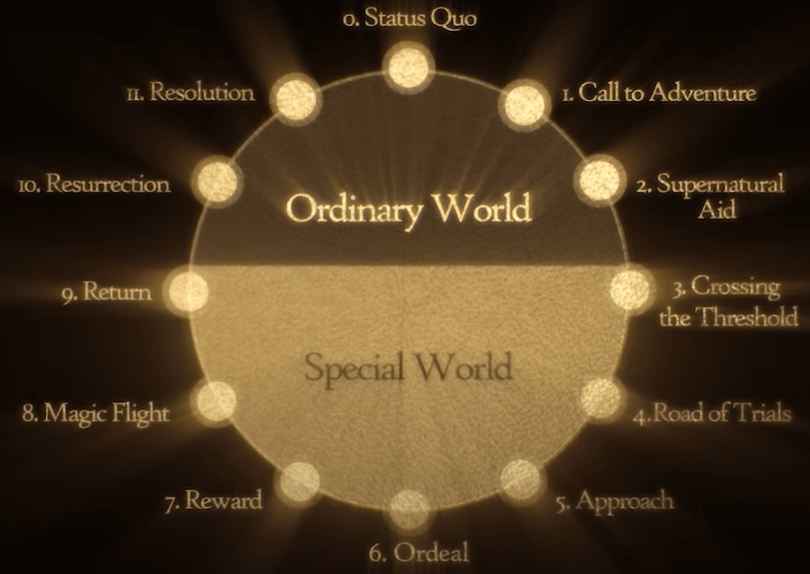
The hero ventures forth from a familiar world into strange and sometimes threatening lands. Campbell proposed we view this as symbolic of the individual’s departure from their conscious personality into the unexplored regions of their unconscious in search of the ultimate boon; the unrealized potentials hidden within.
The hero’s journey always begins with a call to adventure. This call is often personified as an animal the hero encounters, symbolic of one’s instincts or gut feelings which are insightful but too often ignored.
In the words of Campbell: “often in actual life and not infrequently in the myths and popular tales, we encounter the dull case of the call unanswered; for it is always possible to turn the ear to other interests. Refusal of the summons converts the adventure into its negative. Walled in boredom, hard work, or “culture,” the subject loses the power of significant affirmative action and becomes a victim to be saved.
While the call is often initially refused, not all who hesitate are lost there are forces within which understand the importance of the adventure, and act to ensure the call does not remain unanswered forever. In mist these forces are often personified as supernatural helpers, in fairy lore it may be some little fellow of the wood, some wizard, hermit Shepherd, or Smith who appears to supply the amulets and advice that the hero will require. The higher mythologies developed the role of the great figure of the guide, the teacher, the ferryman, the conductors of souls to the afterworld.
Assisted by internal forces the hero eventually answers the call to adventure and ventures off into unknown territory.
At the boundary of the familiar and unexplored regions, the hero encounters the threshold guardian, amidst this guardian is often a menacing being or mephistophelian figure which represents one’s shadow – the portion of one’s personality which has been rejected over time and thus relegated to the surface layers of the unconscious.
In myths, the threshold guardian instills panic among those unprepared to meet him. Just as in real life confronting ones rejected personality can be difficult and distressing. Yet if one finds a way to accept their rejected personality, one gains access to an inner strength which will be of assistance as one descends into the deeper and sometimes threatening layers of the unconscious.
As Campbell explained; “and so what happens that if anyone undertakes for himself the perilous journey into the darkness by descending either intentionally or unintentionally, into the crooked lanes of his own spiritual labyrinth. He soon finds himself in a landscape of symbolical figures, any one of which may swallow him. Descending deeper and deeper into the psyche overcoming trials and experiencing moments of ecstatic insight, eventually, one’s previous self begins to disintegrate and a new more impressive self begins to form.
In myths this stage is symbolized as a death and rebirth, in which the hero enters a dark area such as the belly of a whale, a tomb, or dark cave, and after a period of time emerges from it reborn.
Reborn with a new sense of strength and purpose, the ultimate boon or unrealized potential then is discovered soon after. Finding the ultimate boon is described in different myths in a variety of ways, yet it is always meant to signify an expansion of consciousness and their width of being.
Illumination, Transfiguration, Freedom. While the discovery of the unrealized potentials within is a highly significant moment, it is not the end of the journey. One still must determine how to nourish these potentials and bring them forth in the world.
This can be exceedingly difficult as Campbell explains: “the whole idea is that you’ve got to bring out again that which you want to recover, the unrealized unutilized potential in yourself. The whole point of this journey is the reintroduction of this potential into the world. It goes without saying this is very difficult, bringing the boon back can be even more difficult than going down into your own depths in the first place. As you attempt to bring forth your potential into the world, there’s the possibility that nobody will care or pay attention. There is also the possibility that the applause of others will divert you from your authentic path leading to a life of mimicry or enslavement to the opinions of others.
The optimal possibility is to carve out your own corner of the world, where you can nourish your potential and offer your work to others without concern of applause or fear of rejection.
In doing so you will have found your own unique pathway to bliss, and your life will have followed the thread of the hero’s journey.
“What I think is that a good life is one hero journey after another. Over and over again you are called to the realm of adventure, you are called to new horizons, each time there is the same problem. Do I dare? And then if you do dare, the dangers are there, and the help also, in the fulfillment or the fiasco. There’s always the possibility of a fiasco, but there’s also the possibility of bliss.
 Tau11 - My Journey of Lifelong Learning
Leave a comment